News
Pleated blinds: a solution for attic, triangular and non-standard windows
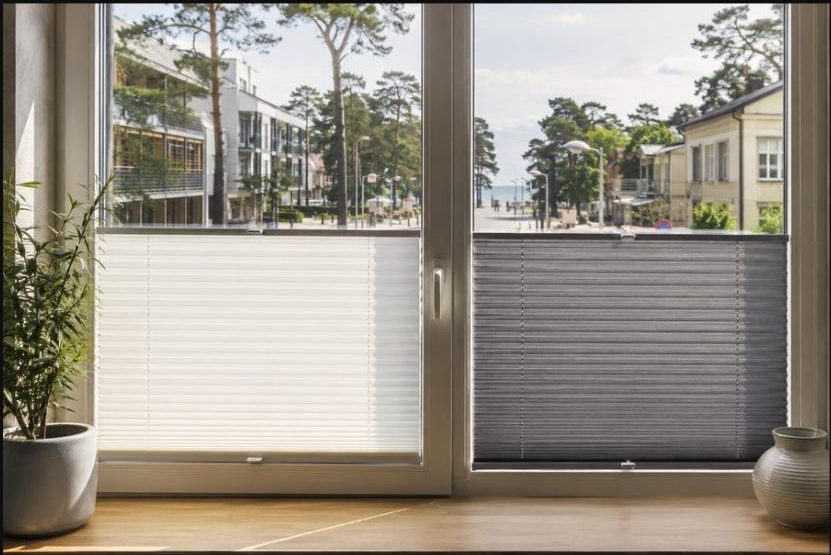
Where a regular blind would sag or simply not fit, pleated blinds hold their shape thanks to guide rails on both sides of the fabric.
Why regular blinds don't work for attic windows
A sloped or horizontal roof window has no vertical surface to hold a blind in place by its own weight. An ordinary blind on an angled or ceiling window sags and stops covering the edges of the opening. Pleated blinds solve this using thin guide cables or profiles on both sides of the fabric — the fabric locks in place at any point, including fully horizontal, and doesn't lose its shape.
How pleated blinds are fitted on a sloped window
The pleated, accordion-folded fabric moves along side rails, so pleated blinds can be fitted not only vertically but at any angle, and in some setups can be moved from both sides toward the centre, letting light in from top and bottom at once.
Energy savings from the honeycomb structure
There's a separate type of pleated blind — honeycomb (cellular) blinds, where the fabric forms closed air cells in cross-section along the whole length. The air trapped in these cells works as an extra insulating layer for the window: in summer, this kind of blind lets in less heat from outside, and in winter it lets out less heat from the room. This is especially noticeable on skylight (attic) windows, which get more direct summer sun than most.
Non-standard window shapes
Pleated blinds are almost the only system that can be precisely fitted to a triangular, trapezoid or arched window: the guide rails are made to the exact contour of the opening, so an unusually shaped window is covered just as neatly as a regular rectangular one.
What we need for the estimate
For skylight and non-standard windows, the exact calculation is done on-site by our surveyor — the shape of the opening and its angle are too specific for an online calculator. For a standard rectangular window, you can see an estimated price straight away in pleated blinds calculator.
FAQ
Are pleated blinds suitable for an irregularly shaped window (triangle, arch)?
Yes, the guide rails are made individually to match the shape of the opening — this is one of the few systems that holds its shape on non-standard windows.
How is honeycomb pleated different from regular pleated?
With honeycomb pleated blinds, the fabric forms closed air cells that add extra insulation in summer and winter; standard pleated blinds are a single layer of folded fabric without this effect.
Can pleated blinds be opened from both the top and the bottom at once?
With some designs, yes — the fabric moves from two guide rails toward the centre, letting you open up light at the top of the window while keeping privacy at the bottom.
Read also: